
You know that frustrating moment when your shower suddenly turns cold? Most water heaters last 8-12 years, but their heating elements often fail much sooner. You’ll notice lukewarm water, no hot water, or it running out too quickly.
But you don’t need to be a plumbing expert to figure this out. Testing a water heater element is actually pretty straightforward, and we’ll show you exactly how to do it step by step.
Tools You’ll Need
Before you start your water heater repair, let’s get your toolkit ready. Here’s what you’ll need:
-
Multimeter
This is your essential tool for water heater troubleshooting. It reads electrical signals and tells you whether your heating element is getting power and working properly.
-
Screwdriver
You’ll use this to remove access panels and reach the heating elements inside your water heater.
-
Safety gloves
They are necessary since you’re working with electricity and potentially hot surfaces.
-
Voltage tester
While optional, this tool helps confirm the power is actually off before you start working. It’s an extra safety measure that’s worth having around.
-
Bucket and towel
Keep these nearby just in case. Even though we’re not draining the tank, minor leaks can happen when you’re working around water heater fittings. It’s better to be prepared than to deal with a mess later.
Read, How Do You Drain a Water Heater?
Safety First: Preparing Your Water Heater
Before you start any water heater repair work, safety needs to be your top priority. Getting shocked or burned isn’t worth the money you’ll save doing this yourself.
-
Turn off the power completely
For electric units, flip the breaker at your main electrical panel. If you have a gas water heater, turn off the gas supply valve. This step is absolutely critical – never skip it.
Know, Electric vs. Gas Tankless Water Heater: Which One is Right for You?
-
Shut off the water supply
Here’s something most people don’t think about: those heating elements stay extremely hot even after you cut the power. Give your water heater at least 30 minutes to cool down before you open anything up.
-
Gather your safety equipment
You’ll need insulated gloves and safety glasses. When your water heater is not heating, it becomes a DIY project; these simple precautions can prevent serious injuries.
Trust me, a few extra minutes of prep work now beats dealing with burns or electrical shock later.
Also read, How to Flush a Water Heater?
Testing with a Multimeter (Step-by-Step Guide)
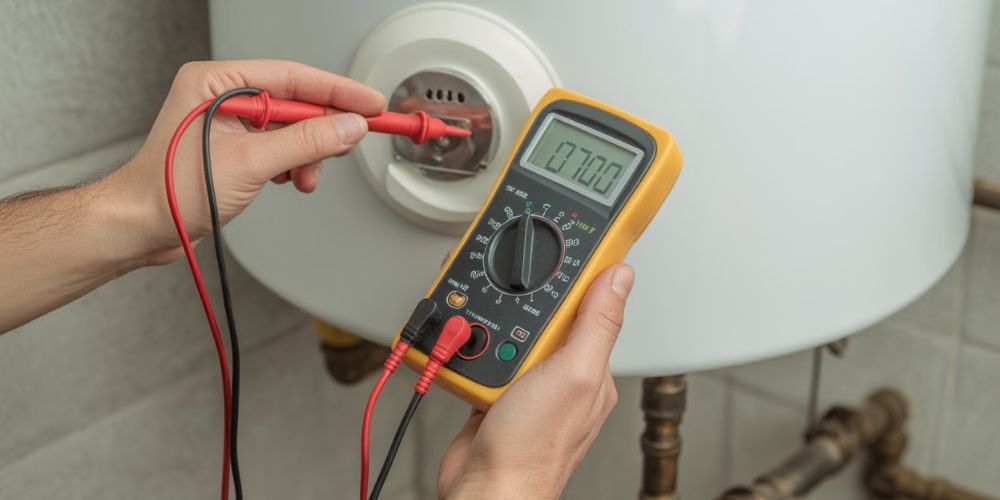
Alright, let’s get your hands dirty and figure out if your heating element is the culprit behind your water heater not heating properly.
Step 1: Set Your Multimeter to Ohms
First things first – grab your multimeter and turn that dial to the ohms setting (you’ll see the Ω symbol).
If you’ve never used one before, don’t worry. Think of it as a detective tool that measures electrical resistance. Most digital multimeters will have this setting clearly marked, so you can’t really mess this up.
Step 2: Test the Element
Here’s where it gets interesting. Take your two probes – one in each hand – and touch them to the two terminals on your heating element.
These terminals are usually pretty obvious; they’re the metal screws where the wires connect. Make sure you’re getting good contact with both terminals simultaneously.
Step 3: Read the Results
Now for the moment of truth. A healthy heating element should give you a reading between 10 and 16 ohms. If you see a number in that range, congratulations – that element is working just fine.
But if your multimeter shows no reading at all (sometimes displayed as “OL” for overload or infinite resistance), or if it reads exactly 0 ohms, you’ve found your problem.
No reading means the element is completely burned out, while 0 ohms indicates a short circuit. Either way, you’ll need a replacement.
Step 4: Test Both Elements
Don’t stop at just one! Most water heaters have both upper and lower heating elements, and you need to test them both.
The water heater repair process often involves replacing just one faulty element, but sometimes both go bad.
This systematic approach to water heater troubleshooting will save you time, money, and a lot of cold showers.
Understanding the Results
Once you’ve tested your water heater element, interpreting what you found is pretty straightforward.
If your multimeter shows a reading between 10-16 ohms, congratulations – your element is working fine. The problem with your hot water is likely somewhere else in your system.
But if you’re getting an infinite reading or no reading at all, that’s your smoking gun. Your heating element has burned out and needs replacing.
Don’t worry, though – this is one of the most common water heater repair jobs, and replacement elements are usually pretty affordable.
Here’s where water heater troubleshooting gets interesting: sometimes you’ll get a reading that’s way off, like 2 ohms or 50 ohms.
This means your element is on its way out. It might still produce some heat, but it’s not operating efficiently. You’ll probably want to replace it soon to avoid getting stuck with cold showers again.
Read: What are the different kinds of water heaters?
Next Steps: Repair or Replace?
So you’ve confirmed your heating element is toast – now what? The good news is that water heater repair for a bad element is usually pretty straightforward and won’t break the bank.
A new heating element typically does not cost much, and if you’re handy with basic tools, you can probably swap it out yourself in about an hour.
However, if your water heater is pushing 10+ years old and you’re dealing with multiple issues, it might be time to consider replacement.
When your water heater is not heating, it becomes a recurring nightmare with different components failing; sometimes, starting fresh makes more financial sense than playing repair whack-a-mole.
Wrapping Up…
Testing your water heater element is honestly the easiest way to figure out why you’re getting cold showers. Just grab a multimeter and spend ten minutes troubleshooting – you’ll know exactly what’s wrong. If you’d rather skip the DIY route, PlumbSmart’s team can handle the whole thing for you.